Negotiations on the part-time collective agreement – a tough start
Dear colleagues,
The Cockpit and Cabin TK committees would like to inform you about the current status of the ongoing negotiations on the part-time CLA. Unfortunately, we have to conclude that there has been little in the way of genuine negotiations so far. We are currently still at the stage of simply exchanging infor-mation with the employer. We have yet to see any concrete proposals or even pro-gress in the negotiations. The discussions include considerations regarding the in-troduction of a 4/4 model for all; the introduction of other models is proving very difficult and may fail due to technical implementation issues caused by the planned changeover of the AIMS planning program.
Our goals are clear:
We are committed to transparent, predictable and fair conditions for part-time ar-rangements. However, the exchange is currently progressing slowly. The other side has so far shown little willingness to negotiate, which we as the bargaining committee strongly criticize. This is unnecessarily straining the patience of our colleagues. What happens next? Despite the slow progress of the talks, further meetings have already been sched-uled. We hope that the employer side will finally be prepared to enter into genuine negotiations and take our concerns seriously. We will, of course, continue to keep you informed of all developments in a trans-parent and timely manner. Your commitment counts! The support of the workforce is our strongest bargaining chip. Show your solidarity – talk to your colleagues, get involved in campaigns and stay informed. The contribution adjustments in accordance with the new VTVs will be imple-mented shortly, which means that your monthly contributions will change. Your TKs are available at any time to answer questions or receive feedback.
With solidarity, Your Cockpit and Cabin TK
Dear colleagues,
We hope you had happy Easter holidays and that you were able to enjoy the days with your families and friends. Even if spring is still a little late, we are starting a special year with fresh momentum!
15 years of German work contracts On May 1, we will be celebrating an important anniversary: our German work contracts have been in place for 15 years – a great success that would not have been possible without the commitment of many colleagues and the strong support of ver.di. This milestone stands for fair working conditions, security and collective bargaining standards that we can be proud of! More for your future: increase in the employer-financed pension
There will be another welcome change from April:
The employer-financed pension will be increased significantly – from 3% to 6.5%! This is a strong sign of recognition and an important contribution to your financial security in retirement.
This month also saw the next increase in our salaries of 3.2%. A big thank you to everyone who is continuously working for improvements in the interests of our employees. Together we are shaping the future – with solidarity, strength and success!
With best regards You Cabin TK
Dear colleagues, dear ver.di members
First of all, we would like to wish you a happy new year. As already mentioned in the brief information at the end of December, we can now inform you that we were able to reach a collective agreement on the company pension scheme.
On 1 January 2017, the employer financed company pension scheme was introduced in the cabin for the first time, for all employees who were on a German contract at the time and with a two year waiting period for all new hires. Nothing has changed since 2017; the employer has always paid 3% of our basic salary into the pension scheme. As 3% is not up to date, we cancelled the Cabin Pension collective agreement last year and renegotiated it with easyJet.
We are pleased to say that from 1 April 2025, the pension scheme financed solely by the employer will increase to 6.5% of basic salary. Together with the salary increase in April 2025 and the newly introduced level system, the amount paid in will increase significantly. In the course of these negotiations, the duration of the pay CLA was extended by 3 months. We have also been able to reduce the waiting period for new employees to 6 months.
Your TK Cabin
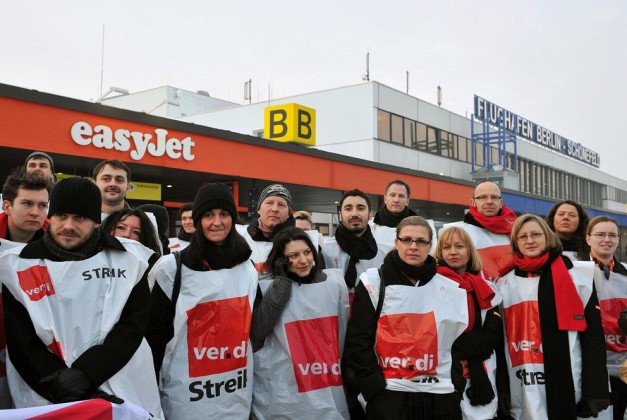
ver.di is calling on the around 450 cabin crew members at easyjet Germany in Berlin to go on warning strike on Friday between 5:00 a.m. and 10:00 a.m. Passengers must expect numerous flight cancellations and delays.
The background to the warning strike is the ongoing negotiations for the employees wage-CLA of the cabin crew members. „The employers have not presented us with a new offer to increase remuneration and thus provoked the warning strike themselves,“ says Holger Rößler, ver.di negotiator at easyjet.
In the current collective bargaining negotiations, ver.di is demanding compensation for the current price increases, but at least a 5 percent increase in remuneration and a one-off payment in the amount of a monthly salary including shift and sector allowance. The term of the collective agreement should be until December 31, 2022.
„The exorbitantly increased prices and the large additional burden on board due to the chaotic restart phase of the entire industry show that our demands are more than justified. It is high time that the cabin crews were rewarded for this,” demands Rößler.
ver.di is the trade union responsible for all easyjet business areas in Germany. These include cabin, cockpit, technology and administration. The Berlin location is the only remaining base in Germany.
There is currently no new hearing date.
Your way is wrong #easyjet
As a crew, we do our good and important work every day. We ensure security and profit. We went through the Corona crisis with the company. Are we supposed to be bleeding out again? Shame on you! Be ashamed of the announcement that you want to terminate up to 275 colleagues. Be ashamed of further reducing our base at BER. Shame on you for treating your loyal employees like that.
We demand a rethink! We have fully booked aircraft. We have good booking numbers. We want a future with the company – and not be sacrificed for the company to save on fees.
Download our Poster: https://verkehr.verdi.de/++file++5f64dbf88048a8d50b42813d/download/Plakate.zip
#generationnotsoeasyjet
Dear Colleagues, Dear ver.di-members,
Please find enclosed the letter which got sent to the easyJet Chair of the Board, Mr Stephen Hester, and our Board of Directors on Tuesday, 05th April.
It is a joint communication signed by Trade Unions across the network and clearly expresses the worrying concerns these unions have regarding the ability of easyjet to cope with the challenges of the upcoming summer season.
It is the unions‘ firm belief that network-wide, crewing levels have been eroded and are thus insufficient to allow for a stable and profitable operation during the summer months.
ver.di and other unions strongly believe that instead of trying to second crew to other bases or activating the “Willing to Fly”-button e.g. in Germany, it would much rather be appropriate to return to more conservative crewing levels – e.g. offer additional pilots a return to full-time and increase efforts to hire additional cabin staff.
The 2022 summer season will inevitably be crucial for the long-term development and profitability of this company and should not be put at risk following an intention to “over-optimize” the business.
Kind regards
Your TK Cockpit
To all members of the AMB,
To all Cabin Crew around the network,
This open letter comes from ALL the Trade Unions’ representing the Cabin Crew
Members of the easyJet network.
COVID-19 has had a dramatic impact on the aviation industry, more than anyone could
ever have imagined. The pandemic led to a dramatic drop on consumer confidence and
flight demand. Nearly one year in this scenario and we continue to rebuild our Company
to come out of this stronger than ever.
Before COVID-19, there was open communication and a constructive relationship
between easyJet and Trade Unions. Nearly one year into this situation and this
relationship has weakened. The Trade Unions, representing the Cabin Crew Community,
always wanted (and wants) its’ best for the community but also for the Company to
strive so we could all maintain strong and save as many jobs as possible.
Throughout this year, we have seen many changes in the Company and around our
network. Bases have closed, redundancies have been made alongside other business
decisions that easyJet claims to be for the future of the Company. easyJet has to act in
a social responsible manner to protect the employees and their jobs.
Whilst we do not disagree that changes have to happen to survive such a crisis, we agree
that the engagement with the Employee Representative Bodies should’ve been strongly
considered and maintained as it was previously.
With this, on the 28th January, all Trade Unions’ requested a meeting with easyJet with
the objective to re-open the communication with both parties and allow the Trade
Unions to share their genuine concern of the lack of engagement with the Employee
Representative Bodies. Being the main goal to be able to work together in a constructive
way.
After re-sending the e-mail, a reply came in and our request for a meeting was rejected and we quote: “we don’t believe it is appropriate to do so with these important but informal bodies at this time.”
This response was very very disappointing and not expected from a Company who’s pledge has always been “open and upfront” and “in it together”. But how can we expect improvement and a constructive path if the only transnational information and consultation body – EWC – isn’t informed about such changes? Bearing in mind that we are still waiting, since last summer, for the official opinion and statement of the EWC, something impossible to have if the Company doesn’t provide the information package needed.
How do we work constructively if the Company refuses to meet us in a quick conference call? We are all aware of the workload present due to the constant changes and regulations in each country and department but please DO NOT tell us that there is no 30 min window available.
On the 25th & 26th March 2019 an easyJet Industrial Relations Conference took place in Luton. May we remind all that were present that easyJet stated that the ambition of this conference was to demonstrate easyJets’ commitment to their employee’s representatives and their organisations. Stating also that this Conference was a two-way interaction, with an opportunity for all to tell easyJet what’s good, not good, feel heard and confident that they’re doing something about it. Many members of the Company spoke, including our CEO Johan Lundgren. It was a cooperative Conference and lead to a constructive working environment. We believe what is happening now is a big step back from what was said in the IR Conference in 2019. We must re-establish this. This huge crisis we are facing now due to COVID-19 must be a time where the communication between both parties is most important. These conferences were an initiative from easyJet, taking in as a commitment for a regular basis, part of the IR Plan, and, due to COVID-19, instead of re-enforcing this commitment, it went the opposite way.
We are aware that communication flows better in some Trade Unions’ than others but we are here today as a WHOLE, although being individual Unions’, TOGETHER in solidarity to express our concerns regarding the lack of engagement with the Employee Representative Bodies. It’s disappointing how easyJet prefers to speak to the Trade Unions’ individually without promoting a group discussion to discuss and express common topics for all, like we used to do with the IR Conferences.
We want to work constructively with easyJet and make this Company strive!
All together and not each party working for itself.
FILT-CGIL FIT-CISL SITCPLA SNPNC SNPVAC SSP UILTRASPORTI UNAC UNITE USO VER.DI VNC
Zur Videobotschaft https://share.vlognow.me/s/1236535
Am 28. Oktober 2020 hatte die ver.di Bundesfachgruppe Luftverkehr zusammen mit der Aircrew Alliance zum Kick-Off „For The Best New Normal“ im Luftverkehr eingeladen. Einem ersten Aufschlag einer nun regelmäßig stattfindenden Veranstaltungsreihe von ver.di und Aircrew Alliance mit Vertretern aus Politk, Wirtschaft(sverbänden) und Unternehmen des Luftverkehrs. Durch COVID-19 im digitalen Format, Fast 30.000 Kolleg*innen beteiligten sich über die Videokonferenzsysteme oder verfolgten die Veranstaltung in Social-Media-Kanälen oder über den Live-Stream im Internet. Dabei waren alle Bereiche des Luftverkehrs vertreten: Von den Bodenverkehrsdiensten (BVD), den Sicherheitsdienstleistern, den Flughäfen, aus allen Bereichen der Lufthansa wie auch das fliegende Personal aus Cockpit und Kabine aller anderen in Deutschland operierenden Airlines.
Eine beeindruckende Teilnahmeresonanz, die jedoch auch zeigt, dass die Beschäftigten im Luftverkehr viele Fragen, Sorgen und Ängste haben. Sie wollen eine Perspektive, eine Zukunft für ihre Tätigkeit im Luftverkehr sehen. Das wurde auch in den hunderten Fragen der Teilnehmer*innen deutlich, die uns vor und während der Veranstaltung zugegangen waren.
In ihrer einführenden aktuellen Bestandsaufnahme hat Mira Neumaier, ver.di Bundesfachgruppenleiterin Luftverkehr, deutlich gemacht, welche Risiken wir sehen, wenn die einzige Antwort der Airlines im Restart ein erneuter Wettbewerb um möglichst billige Ticketpreise ist.
Schon jetzt sind wir von nahezu allen Arbeitgebern im Luftverkehr aufgefordert, „Krisenvereinbarungen“ zu treffen. Damit sollen bestehende tarifliche Leistungen abgesenkt werden, einige Arbeitgeber fordern bis zu 30 % Vergütungseinbußen! Oft wird das nicht nur mit den aktuellen Einnahmeausfällen, sondern darüber hinaus mit einer Neuaufstellung im Dumping-Wettbewerb begründet. Viele Arbeitgeber haben bereits die Streichung von Arbeitsplätzen angekündigt.
Gerade vor diesem Hintergrund begrüßt ver.di die Verlängerung der Kurzarbeit bis Ende 2021 und die Erhöhung des Kurzarbeitergeldes von 80 bzw. 87 % des Nettoentgeltes.
Durch Fluktuation, das Auslaufen befristeter Verträge oder die Beendigung von Leiharbeit arbeiten heute bereits deutlich weniger Menschen im Luftverkehr.
Diese Krisenbeschreibung führte auch direkt zu dem Thema für die Paneldiskussion: „Einfach weiter so? Auf Kosten der Umwelt, der Gesundheit und der Arbeitsbedingungen für 5 Euro nach Mallorca?“
Für die Paneldiskussion waren Christine Behle als unsere stellvertretende ver.di Vorsitzende, Anette Kramme, Parlamentarische Staatssekretärin im Bundesarbeitsministerium (BMAS), Steffen Bilger, Parlamentarischer Staatssekretär im Bundesverkehrsministerium (BMVI) und Mathias von Randow vom Bundesverband der deutschen Luftverkehrswirtschaft (BDL) eingeladen. Digital zugeschaltet waren Claudia Amir, ver.di Bundesfachgruppenvorsitzende Luftverkehr und BR-Vorsitzende Fraport sowie Christian Hirsch, KBR-Vorsitzenden der Deutschen Lufthansa AG.
Moderiert hat Fani Zaneta, persönliche Referentin der stellvertretenden ver.di Vorsitzenden.
Grundlage für die Diskussion war das ver.di Luftverkehrskonzept, dass die Bundesfachgruppe im Sommer 2020 vorgelegt hat. Es beschreibt wie der Luftverkehr bei einem Neustart nach der Pandemie anderen Kriterien außer Wettbewerb und Preisdruck gerecht werden kann. Es enthält Forderungen nach einem anderen Verständnis des Luftverkehrs als europäische und globale Verkehrsinfrastruktur von wesentlicher Bedeutung, verstärkten Klimaschutz und Nachhaltigkeit und einer größeren Bedeutung sozialer Kriterien insbesondere bei der Gewährung von Staatshilfen.
Christine Behle stellte das Luftverkehrskonzept in den Fokus ihrer Ausführungen und machte deutlich, dass wir damit auch der Arbeitgeberlogik, nach der die Personalkosten in gleichem Umfang wie die Umsätze sinken müssen, etwas entgegensetzen wollen. Nur so könne es gelingen, in der Zukunft wieder Arbeitsbedingungen zu erreichen, die es den Beschäftigten ermöglichen, ihre Gesundheit zu erhalten und ihrer Arbeit nachzugehen, ohne dabei krank zu werden.
Dabei zeigen wir auch, dass Klimaschutz und Beschäftigung kein Gegensatz ist. Viele Maßnahmen für mehr Klimaschutz an den Flughäfen, am Boden, in der Technik und bei den Airlines können auch mehr Beschäftigung generieren.
Wir wollen einen anderen Luftverkehr, bei dem soziale, gesundheitserhaltende, ökologische und nachhaltige Kriterien verstärkt Beachtung finden.
Enttäuschend waren die Antworten der beiden Staatsekretär*innen. Zunächst haben wir jetzt die Krise zu überwinden, danach sehen wir weiter, war die zentrale Aussage in dieser Runde. Wichtig sei jetzt, mit Staatshilfen den Unternehmen zu helfen und große weitere Insolvenzen zu verhindern. Damit würde auch die Infrastruktur gesichert. Angesprochen auf die Bedeutung der Beschäftigten, die mit ihrer Arbeit dafür sorgen, dass diese Infrastruktur auch funktioniert, kamen wenig konkrete Antworten. Anette Kramme verwies auf die verbesserte Unterstützung für Qualifizierungsmaßnahmen des Sozialgesetzbuches. Steffen Bilger beantwortete Fragen nach sozialen Kriterien bei der Vergabe von Staatshilfen mit dem pauschalen Hinweis, dass „der Staat nicht der bessere Unternehmer“ sei.
Eine Meinung, der sich auch Mathias von Randow anschloss. Darüber hinaus begrüßte er die schnelle Reaktion der Politik im Frühjahr, mit der die für den Erhalt der Unternehmen erforderlichen Liquiditätshilfen und die Regelungen zur Kurzarbeit möglich wurden. Er betonte dabei auch die gemeinsame Verantwortung der Sozialpartner. Soziale Kriterien? Fehlanzeige! Antwort auf die Frage, dass einige Unternehmen die Krise missbrauchen wollen, um Tarifverträge zu verschlechtern oder zu unterlaufen – Fehlanzeige! Verantwortung der Sozialpartner?
Claudia Amir warb noch einmal dafür, den Restart im Luftverkehr für eine Neuausrichtung des Luftverkehrs und für einen verstärkten Gesundheitsschutz für Beschäftigte und Passagiere zu nutzen. Viele Probleme der Beschäftigten basieren auf einem ruinösen Wettbewerb nach 25 Jahren der Liberalisierung und der Dereguelierung. Wir brauchen eine „Kehrtwende“. Ein einfaches „Weiter so“ nach der Krise hätte katastrophale Folgen für die Beschäftigten, die Passagiere und die Umwelt. Dabei fragte sie gegenüber der Politik auch nach deren Verantwortung für die Beschäftigten.
Abschließend machte Christian Hirsch die wichtige Rolle der Mitbestimmung in dieser Krise deutlich. Am Beispiel Lufthansa erläuterte er, mit welchen Forderungen Arbeitnehmervertretungen und Tarifkommissionen konfrontiert werden und welche Verantwortung sie dabei tragen. Dabei warb er auch für mehr Vertrauen in die Mitbestimmung, die aktuell eher als „lästiger Zwischenschritt bei der Umsetzung von Maßnahmen gesehen“ wird.
Dabei sind die Vorgänge bei der Lufthansa vielleicht prominenter als bei anderen Unternehmen, die Arbeitgeberforderungen sind jedoch weitestgehend ähnlich. Egal ob bei kleineren Bodenverkehrsdienstleistern, kleinen und großen Flughäfen oder bei den Airlines: Personalabbau, Lohnkürzungen, Einschnitte bei der betrieblichen Altersversorgung sind die Antworten der Arbeitgeber auf die Krise!
Gegenüber der Politik warb er für eine Rückkehr zur sozialen Marktwirtschaft. Mit den aktuellen Staatshilfen wird kein sozialverträglicher Personalumbau sondern vielmehr der Weg vom Kurzarbeitergeld zum Arbeitsamt finanziert. Das kann nicht das Ziel einer verantwortungsvollen Politik sein. Er formulierte einen Appell an die Bundesregierung: „Helfen Sie den Menschen!“
Angesichts der vielen hunderte Fragen der Teilnehmer*innen, Fragen nach sozialen Kriterien, wie Tarifflucht vermieden werden kann, welche Qualifizierungschancen es gibt, wird es Transfergesellschaften geben, gibt es einen Ausschluss betriebsbedingter Kündigungen müssen die Beiträge der Paneldiskutant*innen enttäuschend gewesen sein. Die allermeisten Fragen blieben unbeantwortet.
Die ver.di Bundesfachgruppe hat diesen Branchendialog als Kick-Off für weitere Veranstaltungen in unterschiedlichen Formaten konzipiert. In den nächsten Monaten werden (digitale) Gesprächsrunden zu spezifischen Themenblöcken des Luftverkehrskonzeptes angeboten. Zu diesen Themen gehören der Erhalt der Verkehrsinfrastruktur als Dienstleistung im allgemeinen Interesse und die Bedeutung der Beschäftigten, Gesundheitsschutz für Beschäftigte und Passagiere, Nachhaltigkeit und Klimaschutz und zur Gestaltung des Transformationsprozesses unter Mitnahme der Beschäftigten.
Die alle Themen verbindende Fragestellung für die ver.di Bundesfachgruppe wird auch weiterhin die Zukunft des Luftverkehrs nach Covid-19 und die Perspektive für Arbeit und Beschäftigte bleiben.
Wie es jetzt weiter gehen soll, beschreiben Mira Neumaier und Christian Hirsch in ihrer Videobotschaft. Diese findest Du hier: https://share.vlognow.me/s/1236535
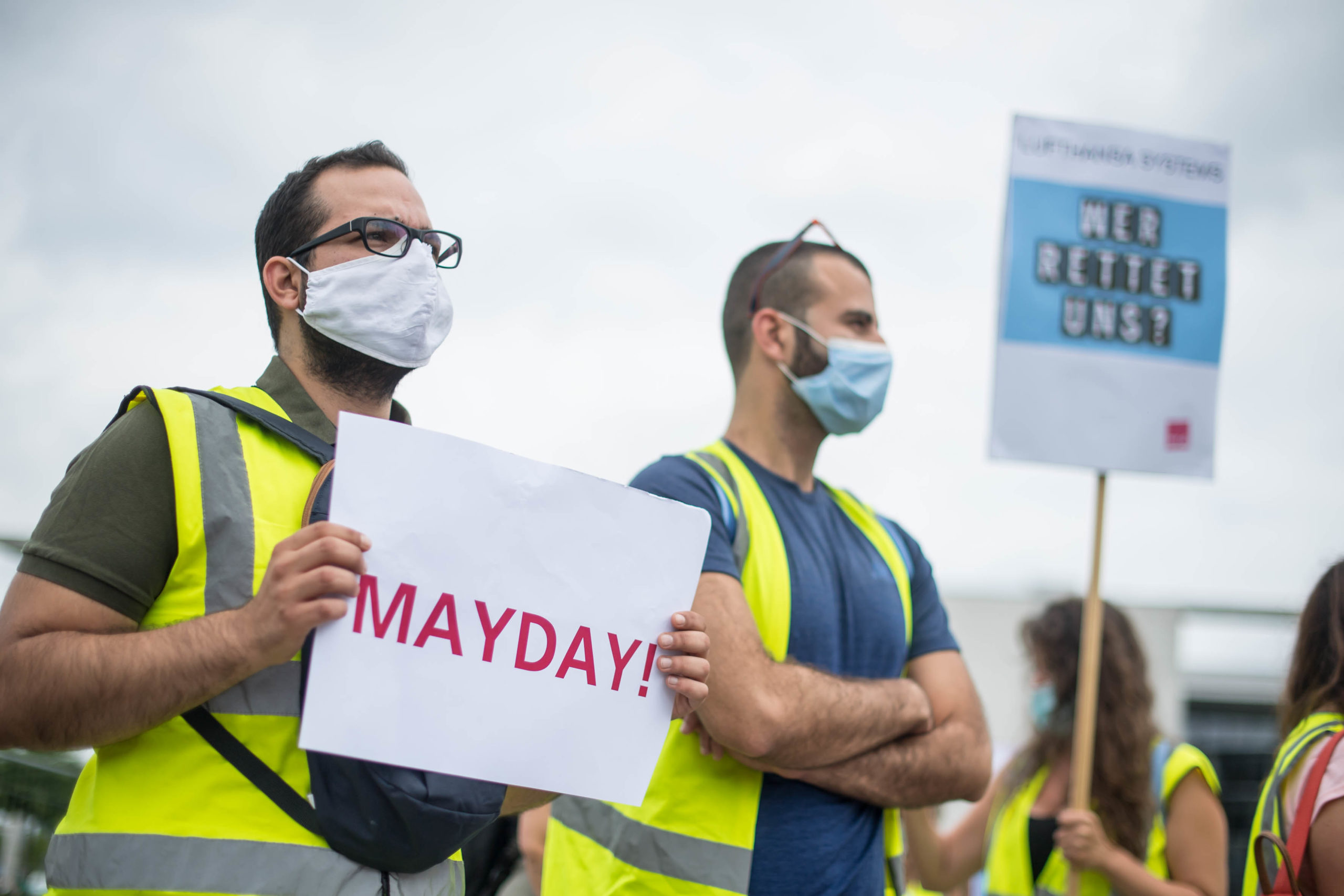
Am kommenden Donnerstag, dem 24. September 2020 ruft die Vereinte Dienstleistungsgewerkschaft (ver.di) Beschäftigte der Fluggesellschaft easyJet zu einer Protestaktion in unmittelbarer Nähe des Flughafens Schönefeld auf.
„Die britische Fluggesellschaft easyJet will ihre Berlin-Flotte halbieren, daher hat ver.di das Unternehmen zu Verhandlungen zur Beschäftigungssicherung aufgefordert. Am Donnerstag wird im Intercity-Hotel am Flughafen mit der betrieblichen Personalvertretung verhandelt und mit der Protestaktion soll der Personalvertretung und den gewerkschaftlichen Tarifkommissionen der Rücken gestärkt werden“, sagt Holger Rößler, bei ver.di zuständiger Gewerkschaftssekretär.
ver.di will erreichen, dass die Arbeitsplätze bei easyJet erhalten bleiben. Tarifvertraglich könnte zum Beispiel vereinbart werden, dass die derzeitigen gesetzlichen Kurzarbeitsregelungen mit dem längst möglichen Zeitraum (d.h. voraussichtlich bis zum 31.12.2021) genutzt werden. Auch die Schaffung neuer und erweiterter Teilzeitangebote, Transfermöglichkeiten in das europäische Netzwerk, verbesserte Möglichkeiten, das Unternehmen freiwillig und mit Abfindung zu verlassen oder auch Vorruhestandsregelungen sind aus Sicht von ver.di geeignete Instrumente, um die Situation zu entlasten. ver.di hat mit easyJet bereits in den vergangenen Jahren gute und faire Tarifverträge sowohl für die Kabinen- als auch für die Cockpitbeschäftigten ausgehandelt.
easyjet hat an seiner einzigen deutschen Basis in Berlin aktuell 34 Flugzeuge stationiert, bereits zum Jahresende 2020 soll nach Ankündigungen des Unternehmens diese Zahl auf 18 schrumpfen. Außerdem ist offenbar geplant, auch die Zahl der Beschäftigten von jetzt 1.540 um 738 ebenfalls zu halbieren. Erst seit Ende 2017 hat easyJet seine Berlin-Flotte deutlich ausgebaut, dazu wurden rund 1.000 Beschäftigte neu eingestellt. Viele von diesen Neueingestellten kamen von der insolventen Air Berlin. easyJet hat auch zahlreiche Start- und Landerechte von Air Berlin übernommen.
easyJet Protestkundgebung: Donnerstag, 24.September 2020 von 9:00 bis 11:00 vor dem Intercity-Hotel in Schönefeld (Am Seegraben 2, B96a)